

Herb Sundays 177: IDM by RamonPang
A Herb Sundays™ Genre Study: See here for more.
Playlist: Apple Music, Spotify
Art by Michael Cina.

Foreword/FWD by Sam Valenti
While the origins of IDM (Intelligent Dance Music, ahem) lie in ‘90s post-Rave Bleep (see Warp’s Artificial Intelligence compilations) with other loom threads like Ambient and Detroit Techno, it’s mainstream moment was modest, namely the 1999 Aphex Twin single “Windowlicker” charting in the UK and major label album trysts by Radiohead and Bjork, Kid A (Parlophone 2000) and Vespertine (Elektra, 2001), respectively. The genre name hasn’t been a going concern for some time, and has been shunned, but its sonic imprint and blissful isolationist energy have endured.

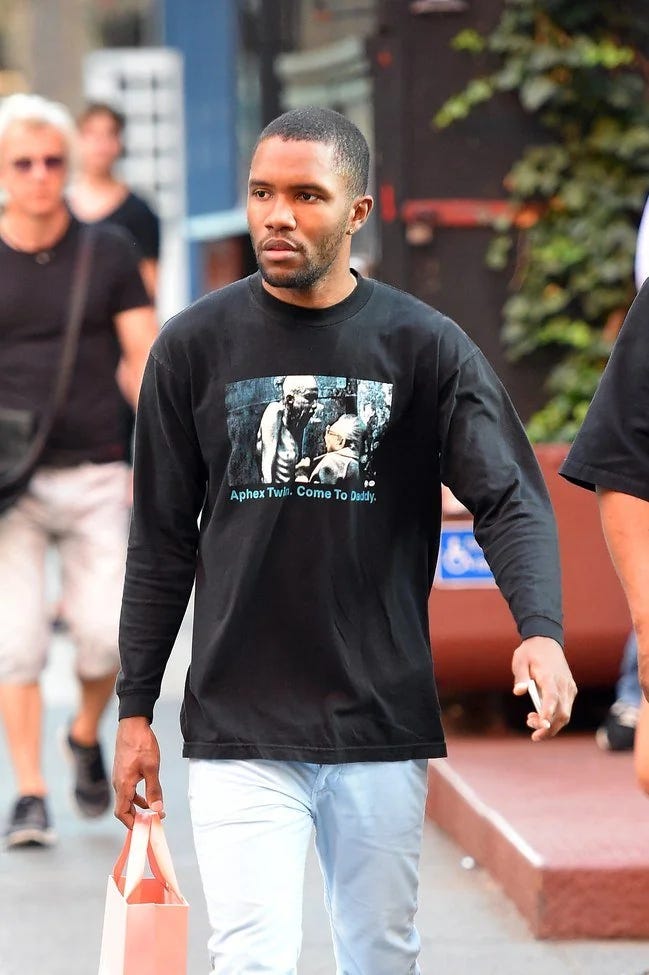
A punchy headline emerged last month, and traveled across media with the realization that, because of a viral moment for 2001 Aphex cut “QKThr” that Richard D. James had indeed briefly surpassed Taylor Swift in YouTube Music monthly listeners, the closest thing Americans will get to understanding the joy of an off-kilter UK Christmas No. 1 single. This wasn’t a lone act; for a while now, we’ve been seeing Frank Ocean wearing vintage Aphex tees, IDM acts like Autechre selling out major venues (with no album cycle or even stage lighting in tow), and post-IDM acts like Oneohtrix Point Never becoming a go-to A24 composer. Apart from a few writers, IDM has lacked face-first celebration, so the face/source of this Aphex chart news was this week’s guest RamonPang, aka California’s DJ/producer/forceful enthusiast and now short-form video king of a genre that never wanted to be seen.
The best IDM music historically sounds like a dark night of the soul: Solitary, moody, working through things. It’s a bit churchy, with an arch energy. It’s lodestar albums, the twin tablets of Aphex Twin’s Selected Ambient Works 85–92 and Selected Ambient Works Volume II (Apollo, 1992 & Warp, 1994), take listeners from post-party buzz to the edge of paranoia and back into moments of sheer bliss. It is pleasing without being pandering, dramatic but ahistorical, personal but antibiographical.
The achievement of these albums, and others of the era, isn’t that they invented instrumental electronic music, far from it, but in furthering a path that faceless, un-flashy listening music could create vast cathedrals of the mind. As Simon Reynolds (Herb 32) wrote in 1998’s Energy Flash: a Journey Through Rave Music and Dance Culture: “Selected Ambient Works Volume II represented a particularly focused and uncompromising investigation of an area that had rapidly become the defining obsession of electronic listening music: sound-in-itself. Sometimes these were ‘found sounds’ from the environment, or drastically processed samples from records, TV and other media. And sometimes they were timbres immanent within antiquated analogue synthesizers.”
IDM finds pleasure in the detritus of the age (the “glitch” or sound of a CD skip is its Fender Rhodes) that takes on a near-spiritual quality. In his 2019 10/10 Pitchfork review of SAW II Philip Sherburne sees the album as an emotional roarschach test in itself: “A little like those samples of Mars’ terrain thought to contain evidence of amino acids but which turned out to be merely tainted with the sweat of some careless lab tech who didn’t pull his gloves on tight enough, Aphex Twin’s creation frequently seems only accidentally contaminated by human emotion. Whatever you feel when listening to it—well, that’s on you.”
If Detroit Techno’s patron saint was Prince, the one-man music worker (Kraftwerk-ian theory), but freaked-up/activated; IDM’s is likely Brian Eno with the vague connection to nature, the academic sincerity, and a twinkle of mischief behind the eyes (the je-ne-sais-quoi of his Roxy Music sequins still hanging in the closet), but also skewing towards the literary (Gibson, P.K. Dick, Ballard, Burroughs), queasily futuristic.
At its most jubilant, classic IDM was prankster-ish, which often was pushed further in the hands of American producers from the Bay Area (the Tigerbeat6 label families) and Miami (Schematic and Co. as a first port of call, as inferred in Laurent Fintoni’s key text, “Going to Miami: How IDM conquered the USA”).
IDM’s train stop on the Hardcore Continuum is likely Drum & Bass via a short bus ride to “drill ‘n’ bass” but this more playful side of the genre is not without its own grace, as in the harshly chromatic beauty of Squarepusher (né Tom Jenkinson), a bassist and an original Rephlex (who offered “Braindance” as an alternate genre tag) label signee, founded by Aphex and Grant Wilson-Claridge. Jenkinson’s album Hard Normal Daddy (1997, Warp) affects a one-man jazz-fusion unit, the aural equivalent of a lonely soul constructing a Showbiz Pizza Rock-afire Explosion band in his basement, tears welling up as he slaps his bass in unison, a lone human member. It is both profoundly beautiful, technologically awe-inspiring, and deeply sad: a lonely, perfect ecstasy and a Herb Sundays Urtext nonpareil.
IDM is comfort food for me with even the first Ghostly full-length is made from this stuff, Tadd Mullinix’s (Herb 105) Winking Makes A Face (Ghostly International Journal, 2000), which sets the tone for maximal/minimal, melodic, and wayward fare that continues through our catalog from Cepia’s Max/MSP-heavy Natura Morta, Telefon Tel Aviv’s expressive catalog (starting on Chicago’s fusion-heavy Hefty Records, also a jumpoff for Scott Herren aka Prefuse73), to Loraine James’ (Herb 145) Whatever the Weather project. It still feels like the future, especially as the web glitches/surrenders.
So why IDM now? It’s intentional obscurity was also a byproduct of a whiteness and maleness to the genre (read: gatekept), with artists like the late Mira Calix and Tujiko Noriko (Herb 114) being gender outliers, but new generations of producers, including Loraine James, Laurel Halo (Herb 134), and Jlin (Herb 109), have pushed and made the sound, even if not always called IDM, more expansive. Its choice labels, like Mike Paradinas’ Planet Mu have evolved too to embrace Grime/Juke/Footwork and more.
A Detroit Techno facelessness has embodied the genre, helping avoid overexposure, with Aphex, of course, being the most face-first, but only as a logo or in comedic death-mask form. James has famously become a LA bikini girl troupe (and their handler), an army of colorful bears, and a gaggle of children/mental hospital patients, all in the hands of fellow enfant terrible Chris Cunningham and with designed doused in the sleek corporata of Ian Anderson’s (Herb 107) firm, The Designers Republic.
IDM has also spawned other tentacles, perhaps reaching to its roots. Its easy to forget Autechre are devout Electro b-boys, like the colorful lining of a suit that is only occasionally seen. Artists like RamonPang have opened the gates for EDM/Breaks/Bass influences to reanimate IDM and adjacent acts like Ninajirachi (who was playing gigs this month with RP in Japan) and ear have expanded the lane.
My own fave cuts sit in the Ghostly IDM/Braindance (Apple/Spotify links) playlist if you want to check more, so while my initial thought for IDM was to go ot an Old Head, I chose Pang as he’s poking at some of the tropes of the genre, and also drawing a different map around the genre, which he outlines below. RP is elated when he finds something new (or old), in contrast to the gatekeeper mentality of yore (IDM fans are the scornful know-it-alls mentioned in The Smiths’ “Cemetery Gates” which, scrambled, is “gacetrye tsem” which could be a mid-career Autechre album cut). He takes heat for his revelations/declarations from haters, he says, who’d prefer normies don’t enter IDM’s dusty stacks, but that’s the price of doing Herb business.
To quote RP’s own mission, one I think he’s been successful in, is in proving experimental music isn’t exclusionary—it’s a journey anyone can take.

RamonPang is a Los Angeles-raised Filipino-American DJ and producer known for genre-fluid DJ sets and his own experimental, bass-heavy music (“imagine Todd Edwards sample chopping up Hiroshi Yoshimura, DJ Icey sneaking in a breakbeat, and Aphex Twin digitally tweaking it from the corner. Add Teddy Riley’s funk, Four Tet’s romantic electronic folk and Rustie’s 2012 Essential Mix chaos, and you start to get the picture.”). Beyond his own work, he co-runs The Tabula Rasa Record Company with Jozef White (who writes the ace Inscripta substack), fostering a new wave of artists like Kelbin (a God in these parts), Crosstalk, canary yellow, Clearcast, and Keenan Mathias.
IDM by RamonPang (notes by RamonPang):
“Here’s why I didn’t understand IDM for years, and why that almost cost me everything.
But let’s do some definitions. Yes, it technically stands for “intelligent dance music” but that’s very non-descriptive. So to me, IDM has about 5 categories in terms of style:
ambient techno + electro, cold percussion, warm synths (Artificial Intelligence series, RDJ’s Analord series)
drill n bass / breakcore. Aka fast music (Venetian Snares)
trip-hop / LA beats / psychedelic stuff (FlyLo, Daedelus, Machinedrum)
abstract, glitchy, flashcore leaning (Richard Devine, late period Autechre)
any combo of the above, mixed with whatever electronic music / bass music (dubstep, drum & bass) / hip-hop tropes (footwork, trap, boom bap, etc) are popular at the time.
Within these, you’ve got dark, brooding stuff or beautiful, lush ambient. That’s at least 10 different combinations. It’s awesome.
I propose an optimistic view for this term. In my conversation with Drew Daniel from Matmos, we pointed out that IDM’s value is descriptive. “IDM” used to imply an intersection of ambient + techno + electro, now it generally means forward-thinking dance music with a ‘freakazoid’ quality and ‘move-your-neck’ thin machine funk. This playlist shows how that philosophy takes different forms, rather than just tying IDM to “stuff that sounds like Aphex Twin.”

IDM artists won’t admit to being called IDM. Why would they? The term’s wrongly associated with pompous non-raving nerds who disrespect ‘dumb, repetitive dance music.’ The “Autechre is better than Aphex Twin” in-fighting is hilarious—people actually use “Aphex’s songs are more accessible” as an insult. But the IDM community is also deeply passionate. But also… this shit is so unserious. The cryptic artwork, nonsensical gibberish names, and inside jokes. Only music this well-crafted and self-serious could produce the most non-serious fans.
A friend compared IDM’s baggage to nu-metal’s baggage—no one wanted to admit liking Limp Bizkit if they liked Slipknot. But nu-metal fans are reclaiming it in the 2020s, and I want to reclaim being an IDM guy. The music stands on its own without pretension about how ‘intelligent’ you are for listening. Sure, it requires patience, but it’s a lock-in you can only do in headphones, not on a club system.
Being into mainstage EDM in college taught me how to listen for sound’s sake. In a DJ set, the audience feels and dances before they understand what’s musically happening. To me, this makes dance music fans the most susceptible to weirdness. After years of adrenaline, it was nice to hear these same sonic tropes in music that felt like ‘jazz’. Being an IDM guy makes me feel like I’m living in the future. Not just because the sounds are futuristic, but because the world of sound and how I process it feels more open.
If I didn’t find IDM, I don’t think I’d have this relationship to the sounds of the world. I almost feel like IDM is a gateway drug into experimental music and musique concrète. The ability to take any sound on its own emotional merit has changed my life and helped me form a more aware relationship with an overstimulating world. I hope it does the same for you. At the very least, maybe it’ll scramble your brain in a way that feels good, instead of draining.
For this playlist, I picked songs that must be played front-to-back to be understood. If you skim through, you’ll likely be confused how you got there. I didn’t include obvious tracks - these are just songs I like from each artist.”
-RamonPang for Herb Sundays
Finally we have a good essay on IDM. I like the idea that IDM is listening to 'sounds-in-itself'. Many thanks!
I feel this too: “The ability to take any sound on its own emotional merit has changed my life and helped me form a more aware relationship with an overstimulating world.”